
Headquarters
11345 SW Hwy K-4
Topeka, KS 66614
Flint Hills Division
26889 Trail Drive Rd
Alma, Kansas 66401


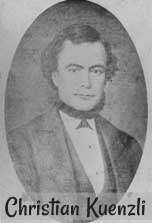
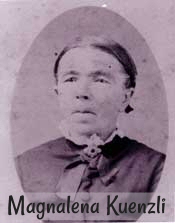
Christian Kuenzli and Magnalena Moser were both born in Switzerland. They came to America in 1850 and met in a cheese factory in Wisconsin. They married in 1853 in Highland, Illinois where their first daughter, Emily was born in 1854.
In 1856 the family moved to St. Joseph, Missouri where two sons were born: Franklin in 1856 and Alfred in 1858.
In 1859, hoping for better opportunities, they traveled by covered wagon to Wabaunsee County where they homesteaded the original quarter section of land. The beautiful Flint Hills reminded Christian of the hills he left behind in Switzerland.
A small stone home was built (later to be used as a cheese house) 300 yards to the North. The family lived there where son Moritz was born in 1861 and daughter Otelia in 1864 while their three level home was being built.
They adopted another boy, John Eastman, whose parents had homesteaded on land 3/4 miles Southwest of their home. They raised him along with their 3 boys and 2 girls. Their oldest daughter, Emily, later married and built what is now known as Mission Manor with her husband, John Schwalm. Click here for more information about Mission Manor.
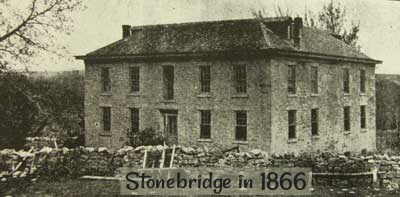
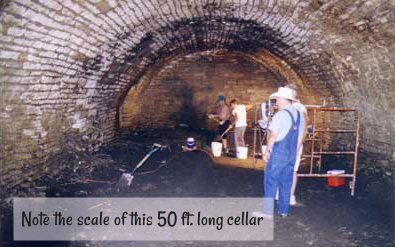
A stone mason named Deihl began construction of the twin stone cellars and home beginning in 1862. The magnificent dwelling, now known as “Stonebridge”, took nearly 3 years to build. However, it was never completely finished inside.
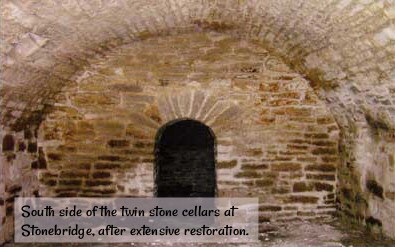
During their lifetime the Kuenzli’s were involved in many land transactions. They raised various kinds of livestock and farmed. In 1874 Christian established the first vineyard in the area and also maintained a very large orchard.
 As they became more prosperous an attempt was made to manufacture cheese. The venture failed due to warm weather, high humidity and the limitations of horse drawn wagons delivering cheese to market locations.
Over the years the Kuenzli’s took in many settlers who were fed and allowed to live with them while being helped to find homesteads of their own. They also made friends with members of the local Indian tribes.
Christian, who was highly respected, passed away in 1899 followed by his loving wife Magnalena in 1900.
The Kuenzli’s son, Moritz and his family then moved into “Stonebridge”. A devastating fire in 1905 gutted the landmark home. The entire second story was removed due to the extensive damage. After a new roof was installed over the remaining level it was utilized as a barn for the next 100 years.
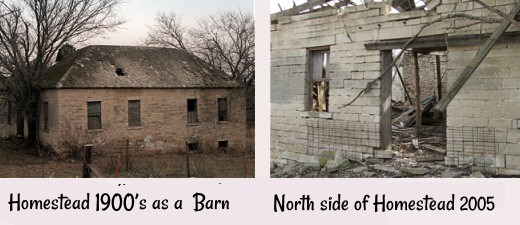
For a total of 145 years, this land was under the stewardship of the original Kuenzli family. Christian and Magnalena retained ownership for the first 40 years of that period.
Their descendants: son Moritz and family, daughter Emily (Kuenzli) Schwalm, Emily’s son Morris and her granddaughter Pearle Redmon continued ownership for the next 105 years.
In the spring of 2004, a family member approached Bill and Kathy Hogue to see if they had an interest in acquiring the land. After driving through the 1,265 acres of Bluestem pasture, crop ground, springs, creeks and natural windbreaks, it was obvious this would provide ideal conditions for their herd of registered Angus cattle.
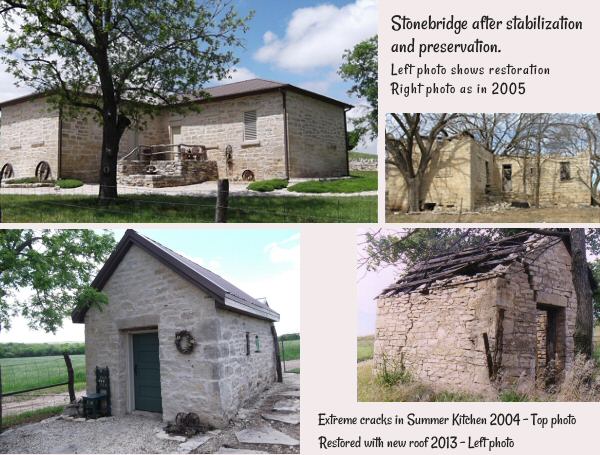
One week later a handshake agreement set in motion what has now become the Flint Hills Division of “Mission Valley Ranch”.
After a century of neglect, Bill Hogue used his experience as a lifelong homebuilder to preserve “Stonebridge” and the adjoining summer kitchen. Once again, the landmark homestead with its twin arched cellars stands proud on the Kansas prairie.
11345 SW Hwy K-4
Topeka, KS 66614
26889 Trail Drive Rd
Alma, Kansas 66401